
Research
My research develops scalable, control-theoretic and systems engineering frameworks for the monitoring, predictability, and control of complex built and natural infrastructure networks. Power grids, water distribution networks, hydrological systems, watersheds, and the global climate share a common mathematical structure: their dynamics are nonlinear, high-dimensional, subject to uncertainty, and often adhere to physical conservation laws. Ensuring the resilience and reliability of these systems depends on our ability to monitor, predict, and control their complex dynamical behavior; yet doing so requires first answering where to sense, how to quantify system properties, and how to localize analysis at a scale at which standard tools do not apply directly.
To that end, my work advances both the theoretical foundations and their application to real-world systems. On the theory side, I develop and extend methods for observability quantification, sensor and actuator allocation, stability analysis, scalable network partitioning, probabilistic node selection, and safety-critical control for nonlinear and differential-algebraic systems that represent most real-world infrastructure. These methods are then validated on and designed for the systems on which societies depend, across both built networks (power grids and water distribution networks) and natural systems (watersheds and climate). The sections below summarize these directions; a complete list of papers is available on the publications page.
Research Areas
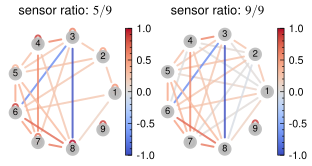 Sensor allocation on a combustion reaction network: selected measurement nodes maximize an observability-based objective with provable approximation guarantees.
Observability and Sensor Placement in Nonlinear Networks
Monitoring large-scale infrastructure networks, even if only partially, is essential for state estimation and control. A central question is where to place a limited number of sensors so that the internal states of a system can be inferred from its outputs over time. I pose this as a combinatorial set optimization problem by exploiting the modular and submodular structure of observability-based objectives, yielding scalable sensor configurations with provable approximation guarantees. The framework retains the full nonlinear differential-algebraic model and incorporates moving horizon techniques to handle uncertainties in system parameters and operating conditions. In power networks, this enables optimal phasor measurement unit placement under load and renewable uncertainty; in water distribution networks, state-averaged observability measures are constructed that remain robust across varying hydraulic and water quality scenarios.
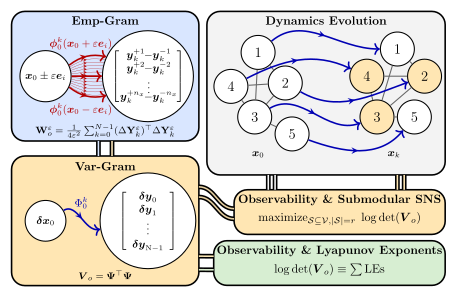 Connecting the variational Gramian, the empirical Gramian, and Lyapunov exponents for nonlinear observability.
Nonlinear Observability via Variational Dynamics and Lyapunov Exponents
Observability for nonlinear systems is less intuitive than its linear counterpart and is often quantified through the empirical Gramian, which requires simulating the system along perturbed trajectories. I establish theoretical connections that link a variational form of the system dynamics to quantitative observability measures, introducing the Variational Gramian (Var-Gram). The Var-Gram is proved equivalent to the empirical Gramian, reduces to the observability Gramian in the linear case, and offers a computationally efficient alternative. Through Lyapunov’s direct method, I further connect observability measures to the Lyapunov spectrum of exponents, relating a system’s sensitivity to initial conditions to how much can be inferred about its states.
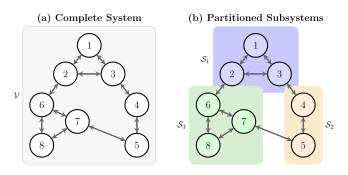 A network decomposed into interconnected subsystems; sensors are selected within each subsystem while preserving global observability.
Scalable Control-Theoretic Network Partitioning
At infrastructure scale, evaluating observability measures over the full network becomes computationally prohibitive, and existing graph-based partitioning methods do not account for the system’s control-theoretic properties. I introduce a control-theoretic partitioning framework that decomposes a large network into interconnected subsystems and simultaneously selects where to sense within each subsystem. The problem is posed as a submodular welfare maximization under a partition matroid, and theoretical bounds are derived that relate subsystem-level observability to that of the full network. A continuous optimization framework based on the multilinear extension is then introduced for scalable computation. This partitioning enables localized analysis of large networks while preserving guarantees on overall network observability, and by duality, the results extend to actuator placement.
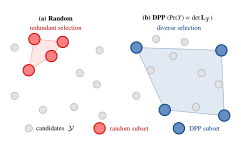 A determinantal point process favors diverse, non-redundant node configurations (right) over redundant ones (left).
Probabilistic Node Selection: Determinantal Point Processes and Gramians
The greedy solution to the sensor selection problem returns a single deterministic configuration, with no probabilistic characterization of nearby informative subsets and no explicit mechanism for redundancy suppression. I reinterpret the node selection problem within networks through determinantal point processes (DPPs), probability models over subsets that favor diverse selections while suppressing redundancy. I show that the observability Gramian parameterized by sensor subsets is a valid DPP kernel, establishing the first connection between DPPs and Gramians in control. This connection opens a new perspective on node selection in networked systems: rather than returning a single deterministic answer, the DPP formulation provides a probability distribution over near-optimal sensor configurations. The probabilistic formulation naturally supports adaptive sensor scheduling, expansion of existing monitoring networks as new resources become available, and practical notions such as sensor budgeting as networks evolve, risk-aware monitoring priorities, and reliability margins under changing operating conditions.
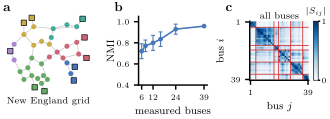 Community detection from measured dynamics on the IEEE 39-bus New England grid: (a) detected communities (colors) with generator buses as squares, (b) detection accuracy (NMI) for different numbers of measured buses, and (c) the observability Gramian, whose blocks reveal the slow coherency areas.
Community Detection through Observability
Community structure is central to the function of complex networks, yet for network dynamical systems the graph is often unknown and only the states of a subset of the nodes are measured. I approach community detection from a control-theoretic perspective and show that the community structure of a network is encoded in the observability of its dynamics. Perturbations of nodes in the same community produce similar responses at the measured nodes, whereas perturbations of nodes in different communities do not, and this distinction is captured by the observability Gramian. The result is a system-theoretic method for recovering communities directly from measured trajectories, without requiring knowledge of the network itself. The approach applies under partial measurements, extends to nonlinear systems through variational and empirical Gramians, and is illustrated on diffusion, stochastic, and oscillator dynamics on benchmark and real networks, including the recovery of slow coherency areas in power grids from bus angle measurements alone.
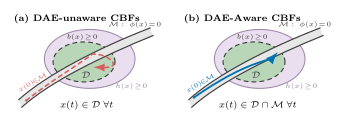 (a) A standard CBF may drive the trajectory off the constraint manifold. (b) The DAE-aware CBF keeps the trajectory on both the safe set and the manifold.
Safety-Critical Control of Differential-Algebraic Systems
Standard control barrier function (CBF) methods, designed for ordinary differential equations, do not apply to differential-algebraic systems because the algebraic constraints impose compatibility requirements that may render safety filters infeasible. In joint work with Hongchao Zhang and collaborators at the Institute for Software Integrated Systems at Vanderbilt, we develop DAE-aware CBFs that construct projected vector fields on the constraint manifold, encode the coupling between dynamic and algebraic states, and ensure compatibility conditions that keep the algebraic constraints satisfied. Sum-of-squares verification is then used to certify both correctness and feasibility of the resulting safety filter. The goal is a unified framework that covers observability, stability, and safety on the same physical model. We also address the case in which the model itself is unknown. With Ben Wooding and collaborators, we derive data-driven control barrier certificates for unknown descriptor systems, showing that trajectories collected on the subspace described by the algebraic constraints are rich enough to guarantee persistence of excitation, which enables the safe autonomous takeover of the system.
Built Infrastructure
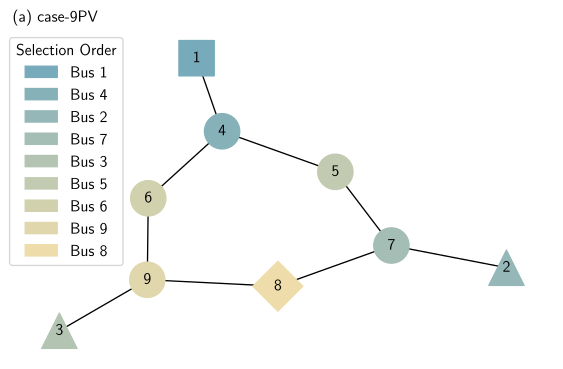 A transmission network with photovoltaic resources allocated at selected generator buses; stability metrics guide optimal placement.
Power Grids
Power grids are most accurately expressed as nonlinear differential-algebraic equations, in which generator transients couple to the algebraic power-flow constraints. I retain this complete model to revisit classical monitoring problems and to study stability. For stability quantification, I derive generalizable metrics based on the Lyapunov spectrum of exponents that simultaneously capture frequency, voltage, and rotor-angle stability, and that quantify how uncertainty from intermittent renewable resources propagates through the network constraints. The result informs operators on which buses best support renewable integration while maintaining overall grid stability.
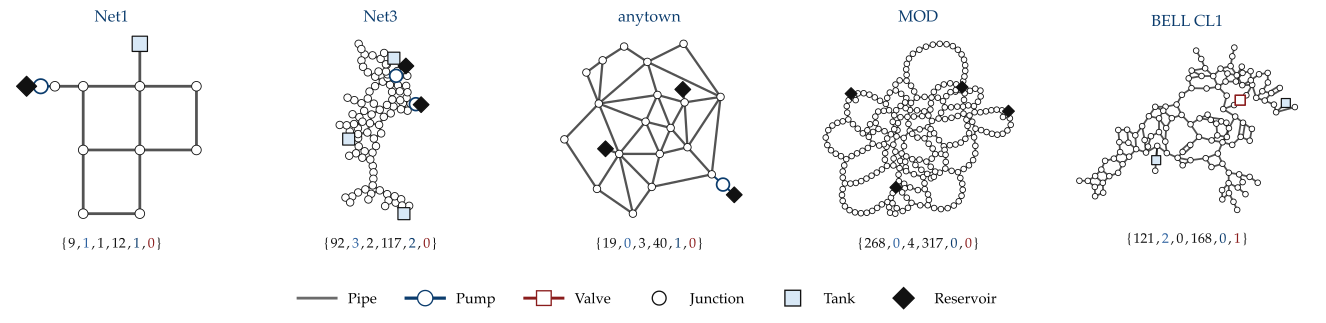 Overview of benchmark drinking water distribution networks used to validate the proposed systems and control-theoretic frameworks.
Water Distribution Networks
Drinking water distribution networks couple water quality dynamics to time-varying hydraulics through flow continuity and energy balance relations. In contrast to single-species chlorine decay models that prevail in the literature, we consider multi-species models that capture the nonlinear reactivity between chlorine and other reactants in the bulk flow and at pipe walls. Building on the sensor placement framework, we construct state-averaged observability measures that retain submodularity under varying demand and water quality scenarios, yielding configurations that remain robust across changing hydraulic conditions. On the control side, in collaboration with Salma Elsherif, we use controllability Gramians to quantify how effectively pump and valve operations can regulate water quality throughout the network, informing quality-aware hydraulic control strategies. We also develop a system-theoretic framework that formulates network hydraulics as a differential-algebraic model, addressing the loss of smoothness introduced by pump and valve switching through regularization techniques.
Natural Infrastructure
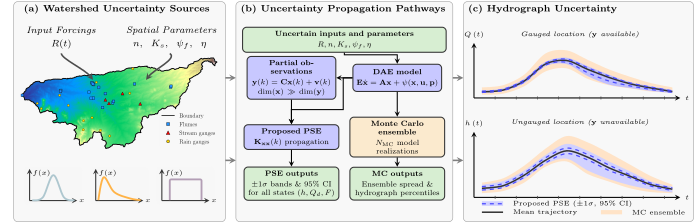 Distribution-agnostic uncertainty propagation in a coupled hydrologic and hydrodynamic system: (a) uncertain rainfall forcings and spatial soil parameters over the catchment, (b) propagation pathways through the differential-algebraic model under partial gauging, and (c) confidence-aware hydrograph estimates at gauged and ungauged locations, validated against Monte Carlo ensembles.
Hydrologic and Hydrodynamic Systems
Accurate overland runoff and infiltration predictions are critical for water resources management and urban flood forecasting, yet they are challenged by uncertainty in rainfall, soil properties, and initial conditions. We formulate overland flow and infiltration as a coupled state-space model based on a differential-algebraic representation, and propagate uncertainty to watershed states under partial gauging in real time. The approach is distribution-agnostic: it requires only the covariances of uncertain forcing inputs and soil parameters to produce distribution envelopes of measured and unmeasured watershed conditions, in contrast to Monte Carlo and Bayesian methods. The framework is validated against Monte Carlo simulations on two catchments.
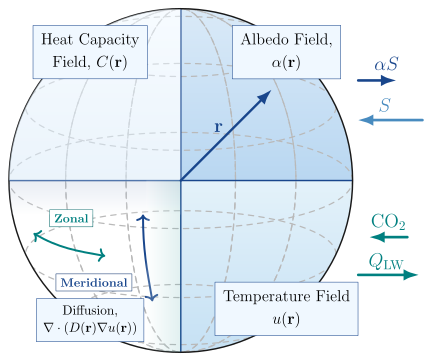 Schematic of a spatially resolved energy balance model: incoming solar radiation, reflected shortwave, outgoing longwave, CO₂ forcing, and meridional/zonal heat diffusion over fields of albedo, heat capacity, and temperature.
Climate and Energy Balance Models
Energy balance models offer a simplified physical approach to climate modeling relative to general circulation models. They reduce numerous radiative features of the surface-atmosphere system through a single parameterization of albedo, the proportion of reflected to total incoming solar radiation; standard albedo parameterizations are limited in real-world application. In collaboration with Gavin Blair, we take a model-identification approach to predicting the rate of change of top-of-atmosphere albedo from real climate data, comparing polynomial and kernel ridge regression predictors against benchmark functions from the energy balance model literature, and quantifying the limitations of albedo identification under coupled temperature and albedo updates.